On Better Terms than I Would Guess they are Today
The tandem of Maria Sharapova and Jimmy Connors did seem a bit unlikely from the outset. I am not sure what led to their hasty dissolution, but I am also not convinced that Connors cannot coach effectively on either the ATP or WTA tours. Also, Sharapova considering a name change to sell candy and having her father fire Connors makes me think Maria was/is in a spot where any coach would struggle connecting with her. Maybe by the fall Maria will have settled into a new coaching arrangement.
Jimmy Connors Greatest Asset as a Coach: Court Positioning
Jimmy Trying to Impose his Court Positioning on a Game Ivan Lendl in 1982
Every era of tennis is going to emphasize aspects of the sport that were not emphasized by a previous era. Some of this is a result of an arms race of sorts. For instance, in 1985 Boris Becker serves big but also possesses mobility that Kevin Curren and Roscoe Tanner lacked. By 1990, Goran Ivanisevic reached a French Open quarterfinal and Wimbledon semifinal and Pete Sampras won his first US Open by combining huge serves with great athleticism.
Beyond the arms race, technologies also change the approach players have to tennis. Today’s strings have made court positioning less important than it once was. Players can hit winners from what had previously been neutral if not defensive positions on the court. Players can also belt winners without necessarily having to work an opponent around the court.
That does not mean that court positioning should be neglected. Consider the success Novak Djokovic had in 2011. A great deal of his dominance centered around taking advantage of his talents and what modern strings afforded him as well as stealing time from his opponents by taking the ball early and controlling the court. Jimmy Connors noted this very thing about Djokovic in 2011:
He gives these guys trouble because he plays a little bit old-school, taking the ball earlier, catching the ball on the rise, driving the ball flat,” Connors said. “And a lot of the topspin the guys drive at him comes right into his zone. He turns defense into offense pretty good.
Djokovic Controlling the Court against a Myriad of Opponents
Connors can help a player with court positioning and perhaps working a point so that either A. his charge gets to knock off an easy volley or B. in a pressure point his charge can move an opponent around and make the opposition hit a passing shot under pressure. Tennis has changed so that this tactic is not as effective as it once was, but it is still effective. The main thing I want to emphasize is that changing stroke production on tour is much harder than changing court positioning. Connors can help a player take what she or he does in terms of striking the ball and instill a more forward minded approach to where to ideally stand.
Possible Scenarios:
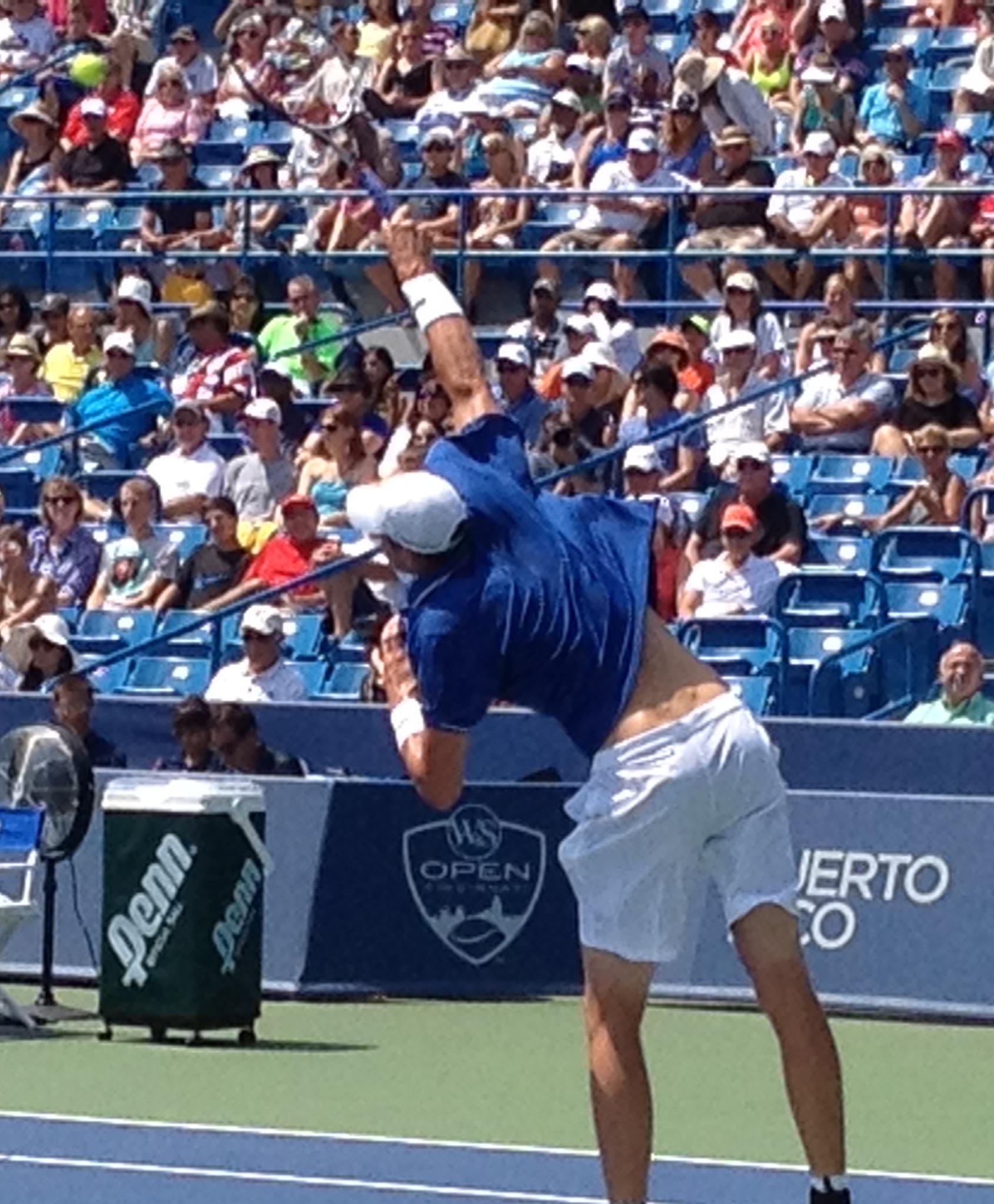
- A player with a big serve who struggles with mobility, court positioning, returning hires Connors to shore up those weaknesses. John Isner or Milos Raonic might benefit from Connors’ input on how to move and return.
- A player such as Caroline Wozniacki who needs to control the court more to return to the top 5 could benefit from picking Connors’ brain.
- A feisty baseline player (a young Lleyton Hewitt) might benefit from Connors promoting self-confidence in a given charge.
- A WTA player such as Angelique Kerber who moves well and is a lefty might also benefit from the lefty-coaching of Connors. Jimmy was raised by women to conquer men so why not help a woman conquer women.
Jimmy would Love Kerber’s Hustle and Fight
Conclusion
I am not trying to question any current player-coach relationships. I do think Connors can help a player on the ATP or WTA tour if he finds the right fit. I’d like to see it because, love him or hate him (I love him), Jimmy Connors always made tennis more interesting. He like any champion is a sui generis creature, but I am sure he can pass along knowledge that would help some players find a better level of tennis.
 Tennis Abides: Dan Martin on Tennis and Life